Thursday, January 31

Wall Street Brawl: Billionaires fling insults on CNBC

Wall Street Brawl: Billionaires fling insults on CNBC

Jeff Cox, Bruno j. Navarro and Patrick Rizzo, CNBC

It was the smackdown when billionaires, which Carl Icahn and Bill Ackman more behaved like bar room Bakugan (complete with expletives such as"Stier-!"), and live televised Friday over their differences on a dietary supplement to hear companies around the world.

"Our goal was a light shine on Herbalife", said Pershing Square founder Ackman on fast money"", referring to the company, which he called "a future-oriented Ponzi scheme." Ackman is Herbalife people lurking, most of low income, in a distribution system accused that he calls fraudulent.

He said Friday on CNBC that dietary supplements "earned company the highest level of control." Ackman has announced recently that he took a massive short position against Herbalife, in the substantial bets that the company's stock will fall.

"Frankly, Carl gave me a favor by picking on me," he said on CNBC.

"Ackman is a liar," said Icahn. "He has one of the worst reputation on Wall Street." Icahn accused company by shorting also Ackman to destroy their shares publicly.

"He is like the crybaby in the schoolyard," Icahn said.

On Friday, Icahn released who has briefly criticized Ackman of the much-publicized in Herbalife, a written explanation. "The record straight, I asked never Ackman be my friend," wrote Icahn. "On the contrary, Ackman has me explained more than once that it is a shame, we're not buddies, because then he could have spent with me. But even if we were friends, I would have never invested with him because I think that taking excessive risks. , I believe this point proves HLF."

Ackman, the company manages $12 billion fortune. Carl Icahn, a colleague is activist investor and one of the richest men in America with an estimated fortune of almost 15 billion $.

Traders on the New York Stock Exchange is the air with "oohs" and "Aahs", while arguing that while social networks, lit with financial journalists and market watchers, Twitter book as fast as their fingers could give.

The setting was, during the final half-hour CNBC's "money fast mid-term report" with Scott Wapner, that so much of the story as the two participants found.

Icahn repeatedly reviled Wapner. Icahn insisted, he was a harassed and repeatedly uses the word "Bull" - his feelings about the on air Forum to describe.

"I really kind of there with Ackman did this guy," Icahn said at an early stage.

"Carl, you think, I would like to invest with you?" Ackman numbers later.

"I would not invest with you, if you were the last man on Earth!" The tenor roared Icahn in one Exchange typical for the show.

The Icahn was the core of the dispute with Ackman's fury over its short position on Herbalife. In turn, Ackman has in a statement that 10 years ago, a legal dispute between the two parties reminds the Icahn Ackman, which pay investors led Thursday $4.5 million plus interest.

While every fighter style points during the battle, when the winner was from the performance of Herbalife are declared, scored a clear victory for Icahn.

The shares of the company rose melee, but profits as much as $2.15 in the half-hour cool then.It was almost like it great theater is important.

Twitter lighted with participants, which desperately posting updates."Move over Snooki and the situation... Here comes the CNBC version of "Jerry Springer with limos" (hat tip Sir Arthur!), "investor, what Doug Kass tweeted.

Asked CNBC's own Jim Cramer, host of "fast money", "whatever happened to would be that of wealth!And simply it referred to financial news Web site business Insider as "The greatest moment in financial TV history."

© 2013 CNBC LLC. All rights reserved

Wednesday, January 30

Congress on budget promise what they can't keep

Congress on budget promise what they can't keep

John W. Schoen, NBC News

Next time, when you hear that someone in Washington come the federal budget balance with a long-term plan, take it with a medium-sized Capitol grain of salt.

As the control and the battle rages on in the capital spending are Democrats and Republicans swear to replace temporary, stop-gap budget measures with a long-term plan, the gap between how much the Government raises in taxes and how much Congress agrees to spend.

Although bitter over like it to pull out divided, both sides agree that a plan step by step, long term, budget balancing would do less harm to the economy than the steep rate cuts short-term issues effectively in a few weeks. Earlier this week, House Republicans set a 10-year schedule for the income and expenditure into line.

"The budget over the next 10 years means that we save the future for our children and our grandchildren balancing", said House Speaker John Boehner, R-Ohio, was announced as the business.

Even if every Member of Congress agreed with this goal, it is a promise that none of them can hold.

Every budget in the long term is subject to a long list of unknown - from disasters and wars, recessions and Finanzkrisen-, which can quickly knock it off course. The list includes a future Congress, which decides to break the plan into pieces and replace with a new one.

"You can talk about a budget as an institution, a sense of direction, but you can not talk on a budget get in the long term as a precise point," said William Galston, senior fellow at the Brookings Institution and political adviser in the Clinton administration. "All sorts of things can change the assumptions underlying long-term planning."

Congress press the "Pause" in the current budget battle this week) due to the delay of a looming deadline, to prevent that the Government of the borrowing to its bills to pay. The business allows the Treasury Department continues to make the distance between the taxes, collects sell bonds and the Congress has the issues.

The measure effectively the debt ceiling crunch until mid-May, moved. The precise date is difficult to predict because the Treasury able to juggle its bills for a few weeks, the borrowing Cap approaching.

The next hard deadline comes with automatic budget cuts - the expenditure side of the so-called "fiscal cliff" - which delayed until March 1 and fell from $24 billion in the last minute, to the end of the year deal, taxes were raised for the richest households.

These cuts, so called "were secrete" in July 2011 after the last debt issued ceiling standoff.

The hope was that the impact of the cuts would be so bad, that the deadline for a compromise in the long-term average of deadlock would compel. Republicans and the White House remain on a collision course over a long-term plan which sequester to replace clever concept for spending cuts of meat.

Both sides agreed a long-term financial plan - invade or to forego their salaries. (This is easier than kept another promise. The 27th amendment envisages that any modification of the selected trust men salaries apply only to the next session of Congress. So the move is largely for map.)

Replace the short-term measures budget with a 10-year plan begins with a set of assumptions about future spending, which are impossible to make. Will the United States fight a war in the next ten years? How many natural disasters such as Superstorm Sandy calls emergency spending? Are health care costs rising faster than the rate of inflation next?

There are more wild guesses embedded in the economic forecasts used to estimate how much money that the Government takes taxes. It will enter a recession in the next 10 years? If so, will it be mild or severe? Short or long?

As all of them have long-term plan a relatively small miss a great influence on the street this estimate. If the current $16 trillion U.S. economy in the historical average speed 50 years by around 3 percent, for example, in 10 years gross is growing gross domestic product - a rough measure of the income of the country is $21, hit 5 trillion. If the growth rate at the current, meets only about 2 percent pace, GDP $19.5 of trillion less tax revenue from businesses and households to generate, even if tax rates remain stable.

"A lot of problems, you can resolve if you simply create in the kind of economic performance we've seen in the last six years by Reagan or the last five of Bill Clinton," said Galston. "It is possible to do everything on paper, if you do not what you do."

Tuesday, January 29

Microsoft profit forecast slightly beaten

Microsoft profit forecast slightly beaten

Although the sales of Windows 8 is not as impressive as investors hope that revenue in Microsoft's Windows Division rose 24 percent over the previous year.

Microsoft said that it had more than 60 million copies of Windows 8 license. The revised system that puts car as its predecessor, Windows 7 on the same early sales after it came out in 2009.

Investors have already signaled their disappointment with Windows 8 and the surface. The overall market floats Redmond, Washington, the shares of the company around the same price as when these products were released three months ago, while later increased.

So far, tech earnings were mixed. On Tuesday, missed IBM profit and sales exceeded Wall Street expectations for the Apple sales forecasts on Wednesday, send the stock already squeezed even deeper in trading on Thursday.

Monday, January 28

Unemployment claims drop, to a five year low

Unemployment claims drop, to a five year low

Reuters

At the lowest level a hopeful sign for the sluggish labor market fell since the early days of the 2007-09 recession, the number of Americans filing new claims for unemployment benefits unexpectedly.

First claims for State unemployment benefits 5,000 fell to a seasonally adjusted 330,000, its lowest level since February 2008 the Department of labor said Thursday.

Claims have now fallen just two weeks suggesting that if employers fear does not tax increases that affect this year put in place on consumer demand, more layoffs.

By Reuters surveyed analysts had expected claims to rise to 355,000 last week.

Economists have cautioned about read too deeply into this month pay as claims tend to loose, to be this time of year. This is due to the large variations in the model will be to iron out from the Department to the seasonal fluctuations.

The labour market showed yet to improve a level for the tendencies of the market health. 351.750, The lowest level since March, 2008 was the four week moving average for new claims, 8.250.

An analyst said Labor Department claims data were estimated last week for three States, but there was nothing unusual in the level of State data.

Claims are now at about the same level they were in much of 2006 and 2007 began claims trending higher to, the recession of the country began the month of December 2007.

While employer layoffs have pulled back, they have added but only orders for the economy at a lackluster pace.

Adding 155,000 new positions in December and the unemployment rate held constant at 7.8% employer.

Job gains averaged 153.000 jobs per month in the year 2012, from 2011, little changed. The sluggish labour market and the inflation pressure appears subdued probably fed on their ultra to keep easy monetary policy stance.

The claims report showed the number of people who survived after a regular State programs after services sank first week help 71,000 to 3.16 million in the week ended January 12.

Copyright 2013 Thomson Reuters.

Sunday, January 27

Apple earnings of top forecast, revenue hapert

Staff report, CNBC.com

Apple reported the result of the edges at the Wall Street fell estimates on Wednesday but its revenues slightly behind the forecasts in the quarter crucial holiday.

In extended hours trading, the company's shares fell after the announcement of the result. (Get the latest offers for Apple after the closing bell.)

Exclude objects from $13.81 per share, down from $13.87 result fiscal year obtained a share in the same period of last year in the first quarter of the company.

Sales rose 18 percent to $54,51 billion from $46,33 billion a year ago.

Analysts had a consensus estimates from Thomson Reuters the company expected revenue, earnings excluding items of $13.47 per share to $54,73 billion.

Apple sold in the period, up from 37 million to 47.8 million iPhones a year; 22.9 Million iPads, increase of 15.4 million per year 4.1 Million Macs, down from 5.2 million a year; 12.7 Million iPods, down from 15.4 million a year ago. The company said that its gross margin was 38.6 percent.

In the wake of the result beats Google and IBM on Tuesday looking to assess investors to Apple's quarterly report, such as the company's market share during the holiday season passed crucial. Apple's stock is the latest iteration of its popular smartphone since the company iPhone 5, debuted to more than a quarter of fallen.

Saturday, January 26

Small businesses are tax security, political uncertainty

Small businesses are tax security, political uncertainty

Allison Linn, NBC News

Shouted Jeff Schneider ever recently its busiest November and December, as the tax preparer small business information, such as the fiscal Cliff negotiations could affect their taxes.

"It was incredible," said Schneider, who directs SFS taxes and accounting in Port St. Lucie, Florida

The last minute offer to avert the fiscal cliff of left clients at least to know what their tax bills would look like.

But Schneider said that he will stop some gripes in the midst of the ongoing political bickering over the debt ceiling, spending cuts and other issues. This is despite the fact that some speak even about their business expand or the opening of new locations.

"If you speak they tell the people face to face, that the economy stinks, but they're talking about as economically, politically", said Schneider, whose kunden include doctors, dentists, a pawn shop, and even an oxygen bar.

It is no secret that the Americans fed up with all the political squabbling over taxes, spending and debt of the Federal Republic. For some small business owners, the frustration with fear is whether or not coloured: they are concerned that the Congress will hurt the economic recovery the inability to find common ground, and cut into their business.

Bill Darling, Chief Economist, who said the National Federation of independent businesses, one of four companies the small business trade group in December said that it was a bad time to expand because of the political uncertainty. This is despite other signs that the economy is slowly better in areas such as housing and employment.

He said that many small businesses also reported that issues such as insecurity, Government, politics, and health costs involved their top issues.

He said "things, which you think, that companies make, was way down on the list". "Government dominates the top of the list."

Taxes are not the only problem it says has the potential to hurt small businesses. The small business trade group has been an outspoken opponent of President Barack Obama health care plan, the affordable care Act. The Group was a lead plaintiff in the proceedings of the Supreme Court, which tries to stop the plan.

Dark mountain said that it is too early to say whether political concerns and Government bonds ease in January, now that the fiscal Cliff problems are fixed. Congress is still on other issues such as the nation of credit recording limit and possible federal spending cuts scramble. Both could rely with the Government or else small business owners damage, the agreement on government spending.

But some say that for many small business owners with whom they work together, the fiscal Cliff negotiations were the major possible distraction, because it directly affects their taxes.

"When finally made the compromise, I think a general sigh of relief, at least something was, what had happened there", said Kim Loewer, a tax practitioner, operates Lower and employees in Weyridge, VT. "The uncertainty was gone away."

Now, many of the MOM and pop shops he works with know what are their tax liabilities, said Lower, that they can better plan for things like hiring and expansion.

In General, Lower, said that his customers that the entire spectrum of advisers to retailers lead - usually reports that business is going well.

"I don't hear as much about the economy not more where is", he said. "I think that right now, from the point of view of my clients, we have seen, to do better this year, an uptick in the economy (and) their business."

Schneider, the tax preparer in Florida, said that he will be expanded advertising efforts and social media for its own accounting and bookkeeping for small businesses. This is on the theory that more money for marketing draw in more customers, even if the economy is not so strong.

He is even in his wife, interior designer, to combat the effects of the recession and the weak economic recovery.

He said 'I your Feng Shui my Office made so that I could get rid of the bad mood'.

Friday, January 25

Billionaire heiress: I'm 'rich and boyfriendless'

Billionaire heiress: I'm 'rich and boyfriendless'

Robert Frank

Being an heiress is harder than you'd think.

There's the pressure of living up to your parents, the spotlight of the media and, of course, the daily dilemma over which diamond-dog collar to put on your pocket pooch.

But China's richest heiress has expounded on another problem: boyfriends. Or the lack thereof.

Zong Fuli, 30, the daughter of beverage magnate Zong Qinghou (net worth around $12 billion), tells the Chinese edition of Marie Claire that she is "rich and boyfriendless." She says she can't find a regular nice guy, and that men simply want her for her money.

"I feel pessimistic about love. Quite often it is hard for girls like me to find a boyfriend. Everyone knows this," said Miss Zong, who went to Pepperdine University in California and works at her dad's drinks empire.

"I have simple requests in love. He could be someone who sends me text messages every day with simple greetings such as asking whether I've eaten yet, or when I am going to bed. Just a little love and caring would be enough for me. But it is very hard to find a man like this, really."

She said that most men "just want to do business."

Needless to say, throngs of single Chinese men have offered themselves to Zong on the internet. (Before you ask, no I don't have her email address or number.) "I will be your Prince Charming," wrote one suitor.

Shentan Chenxing, a blogger, said "gold and property will always be more reliable than men." Others suggested a simple pre-nup would solve her dilemma.

Another had a more drastic solution: "Fake a new identity and get a low-key job. Then you will find true love."

Thursday, January 24

HSBC to pay $249M to end foreclosure reviews

HSBC to pay $249M to end foreclosure reviews

Aruna Viswanatha , Reuters

HSBC Holdings Plc agreed to pay $249 million to end a case-by-case review of past home foreclosures in the United States, bringing the total payout by banks to resolve related issues to $9.3 billion.

London-based HSBC agreed to pay $96 million to eligible borrowers who lost their homes to foreclosure in 2009 and 2010, and provide $153 million in other assistance, including loan modifications and forgiveness.

HSBC said in a statement it was pleased to have reached the agreement and expects to record a pre-tax charge of $96 million in the fourth quarter of 2012 for the cash portion of the settlement. The bank said it expected to cover the loan assistance through existing reserves.

The settlement, with the Office of the Comptroller of the Currency and the Federal Reserve Board, is the 13th the agencies have reached this month.

They stem from reviews of individual loan files the regulators ordered in 2011 and 2012, after widespread mistakes were discovered in the way mortgage servicers had processed home seizures.

The reviews, initially expected to determine which borrowers were harmed and to compensate them based on their individual experiences, proved slow and expensive.

Ten banks, including Bank of America, Wells Fargo, Citigroup, and JPMorgan Chase, agreed to pay a total of $8.5 billion - some in cash, and the rest in loan assistance - to end the reviews last week.

On Wednesday, Goldman Sachs and Morgan Stanley agreed to a similar $557 million deal.

Around 112,000 borrowers whose homes were in foreclosure with HSBC Bank and other HSBC subsidiaries will receive some cash, regulators said.

Regulators said last week the payouts will be based on whether a borrower falls into one of 11 categories. The categories include whether the person was eligible for protections under the Servicemembers Civil Relief Act, whether the borrower was not in default, or whether he or she was denied a loan modification.

The Fed and OCC are expected to reach similar agreements with other servicers that had been asked to conduct the reviews, including Ally Financial Inc, EverBank Financial Corp and OneWest Bank FSB.

Copyright 2013 Thomson Reuters.

Wednesday, January 23

Vatican denies flaws that led to credit card block

VATICAN CITY - The Vatican insisted on Sunday that it had taken adequate measures to combat money laundering and so could not understand why the Bank of Italy had blocked the use of credit and debit cards inside Vatican City.

The central bank stopped Deutsche Bank Italy from providing electronic payment services for the Vatican on January 1 because the Holy See was seen as lacking anti-money-laundering controls and oversight, a move that left thousands of tourists visiting the Vatican museums and gift shops in the lurch, forcing them to use cash.

"I am truly surprised," Rene Bruelhart, the head of the Vatican's Financial Information Authority, told the Corriere della Sera newspaper in an interview Vatican Radio posted on its website.

Bruelhart, 40, said the Holy See had implemented EU-required controls and did not understand the action.

"The reality is that, considering the particular nature of the Vatican City State, adequate measures have been adopted for vigilance, prevention, and fighting money laundering and financing terrorism," he said.

The Bank of Italy said Deutsche Bank had installed machines for payment with credit and debit cards in the Vatican - a tiny city-state surrounded by Rome - without Italian permission after an agreement with another bank expired.

The sale of postage stamps, memorabilia and admission tickets to the Vatican Museums, home to art treasures including Michelangelo's Sistine Chapel frescoes, are a significant source of income for the Holy See, along with donations and investments.

In 2011, 5 million museum visitors brought in 91.3 million euros ($122 million), according to the city state's annual financial report, in which it posted its worst budget deficit in more than a decade.

Mixed grades

Bruelhart, a Swiss national from Fribourg, was for eight years the director of Liechtenstein's Financial Intelligence Unit, the department that gathers and analyses information used by police to combat money laundering, organized crime and the financing of terrorism.

He began working for the Vatican in September, two months after the publication of a landmark report by Moneyval, a department of the Council of Europe, on the Vatican's efforts at financial transparency.

Moneyval gave the Vatican an overall pass grade on transparency-related criteria but fail grades in seven key areas.

The report identified serious failings in the Vatican's bank, officially known as the Institute for Works of Religion, which has been enmeshed in several scandals over the years.

"Moneyval affirmed that the Holy See has a system of preventing and fighting money laundering and the financing of terrorism, equivalent to and recognized at the international level," said Bruelhart.

But a Bank of Italy statement said that while Moneyval recognized that the Vatican had made progress in financial transparency, "the presence of an effective anti-money-laundering regime had still not been proved".

The Moneyval report was particularly pointed in its criticism of the management of the IOR and strongly recommended that it be independently supervised and that "fit and proper criteria" should be applied to senior management at the IOR.

The IOR is being investigated by Italian magistrates looking into money laundering. The bank has denied all wrongdoing.

The Vatican has struggled to shake off a reputation for opaque finances that dates back to 1982, when Roberto Calvi, an Italian known as "God's banker" because of his links to the Vatican, was found hanged under London's Blackfriars Bridge.

The IOR was entangled in the collapse of Calvi's Banco Ambrosiano, with its lurid allegations about money-laundering, freemasons, and mafia links.

The IOR then held a stake in the Ambrosiano, at the time Italy's largest private bank, and investigators alleged that it was partly responsible for the bank's fraudulent bankruptcy.

Tuesday, January 22

US comes in 10th on index of world's freest economies

US comes in 10th on index of world's freest economies

Ansuya Harjani , CNBC.com

The Asia-Pacific region is home to the world's freest economies, according to an index published on Thursday as Western economies grapple with too much government involvement.

Of the world's 10 freest economies, Hong Kong, Singapore, Australia and New Zealand, took the first four places, respectively, on the 2013 Index of Economic Freedom, published by think tank the Heritage Foundation, and the Wall Street Journal. These countries retained their top four positions from 2012.

The world's largest economy, the U.S., came in at number 10. While no euro one country made it to the top 10 in economic freedom, Switzerland and Denmark were placed 5th and 9th respectively.

The ranking, which covers 185 countries, is based on 10 factors ranging from freedom in trade and labor markets to the extent of government spending.

North Korea is the most "repressed" economy, according to the index, with Cuba running second. A handful of countries are listed as "Not Ranked," including Afghanistan and Iraq.

Hong Kong and Singapore have occupied the top two spots since the Index was launched almost two decades ago, owing to their efficient and transparent legal frameworks, vibrant engagement in global trade and investment and low tolerance for corruption, according to the Heritage Foundation report.

"The biggest freedom area is still Asia, (it) remains the brightest spot in terms of economic freedom. There are no euro currency countries anymore in the top 10. It was not really a good year for economic freedom," Edwin Feulner, president of the Heritage Foundation told CNBC on Thursday.

In 2013, Ireland fell down the ranks from 9th to 11th place, which meant that no country from the single currency bloc is represented in the top 10. Other European nations including France, Greece, Italy, Portugal, and the United Kingdom each received scores similar or lower than those they first registered nearly two decades ago.

Overall, 35 countries saw declines in their economic freedom scores by one point or more over the past year, compared with 31 countries which saw an increase of that magnitude, which Feulner said is a reflection of policy stagnation. Each nation is marked on a scale of 0-100, with the latter representing the most freedom.

While on the whole government spending scores improved as many countries attempted to restrict their rapid budget growth, regulatory efficiency marks declined as a number of governments increased minimum wages and tightened control over labor markets.

The U.S. score fell to 76 from 76.3 in 2012 - the fifth straight year of decline. It is now at its lowest level since 2000. It also came in below neighboring Canada – which was placed 6th.


"Entrepreneurial growth is stifled by evermore-bloated government and a trend toward cronyism that erodes the rule of law," Feulner wrote.

Hundred new major federal regulations have been imposed on business operations in the U.S. since early 2009 with annual costs of more than $46 billion, according to the Heritage Foundation.

For the U.S. to restore its economic freedom, it requires "significant policy reforms," particularly in "reducing the size of government, overhauling the tax system, transforming costly entitlement programs, and streamlining regulations," Feulner said.

Monday, January 21

Boeing 787 suffers third mishap in as many days

Boeing 787 suffers third mishap in as many days

NBC News staff and wire reports

Boeing Co's 787 Dreamliner jet suffered a third mishap in as many days on Wednesday, heightening safety concerns after a string of setbacks for the new aircraft.

Japan's All Nippon Airways said it was forced to cancel a 787 Dreamliner flight scheduled to from fly from Yamaguchi prefecture in western Japan to Tokyo due to brake problems.

That followed a fuel leak on Tuesday that forced a 787 operated by Japan Airlines to cancel take-off at Boston's Logan International Airport, a day after an electrical fire on another 787 after a JAL flight to Boston from Tokyo.

Asian customers rallied behind the U.S. planemaker, however, saying such teething troubles were not uncommon on new planes and confirming they had no plans to scale back or cancel orders for the aircraft, which has a list price of $207 million.

Japan is by far the biggest customer for the Dreamliner to date, with JAL and All Nippon Airways (ANA) operating a total of 24 of the 49 new planes delivered to end-December. The aircraft entered commercial service in November 2011, more than three years behind schedule after a series of production delays. Boeing has sold 848 of the planes.

JAL spokesman Kazunori Kidosaki said the carrier, which operates seven Dreamliners, had no plans to change orders it has placed for another 38 aircraft. ANA, which has 17 Dreamliners flying its colors, will also stick with its orders for another 49, spokesman Etsuya Uchiyama said.

State-owned Air India, which on Monday took delivery of the sixth of the 27 Dreamliners it has ordered, said precautionary measures were already in place and its planes were flying smoothly. "It's a new plane, and some minor glitches do happen. It's not a cause of concern," said spokesman G.Prasada Rao.

There was no immediate suggestion that the 787 Dreamliner, the world's first passenger jet built mainly from carbon-plastic lightweight materials to save fuel, was likely to be grounded as investigators looked into the fire incident.

Air China, which sees the 787 as a way to expand its international routes, and Hainan Airlines also said they were keeping their orders for 15 and 10 of the planes.

"New airplanes more or less will need adjustments, and currently we have no plans to swap or cancel orders," said an executive at future 787 operator Hainan Airlines, who was not authorized to talk to the media and did not want to be named.

Qatar Airways Chief Executive Akbar Al Baker, who has previously criticized technical problems or delays with Boeing or Airbus jets, said there were no technical problems with the five 787s currently in use by the Gulf carrier.

"It doesn't mean we are going to cancel our orders. It's a revolutionary airplane," he said.

Other carriers already flying the Dreamliner are Ethiopian Airlines , LAN Airlines, LOT Polish Airlines and United Airlines .

40 gallon spill

The fuel leak on Tuesday was noticed at about 12:25 p.m. ET after the plane had left the gate in preparation for take-off to Tokyo. About 40 gallons spilled, and the jet was towed back to the gate, where passengers disembarked, said Richard Walsh, a spokesman for the transportation authority.

The plane departed about four hours behind schedule and was due to arrive in Tokyo on Wednesday evening.

No passengers or crew were injured in either incident, though firefighters were called out on both occasions.

Boeing shares fell nearly 2.7 percent on Tuesday, following a 2 percent drop on Monday - wiping around $2.8 billion off its market value, or more than a dozen Dreamliners at list price.

While many Wall Street analysts rate Boeing stock a 'buy' or 'outperform' - the manufacturer has delivered jets faster than the market predicted - some noted the potential for the combination of a fire and a fuel leak to affect public perception of Boeing and the new aircraft.

People working at OG Travel and Eurex, travel agents in Tokyo, said they had not seen any impact on reservations on flights using the 787 aircraft. "I've not heard of any cancellations following these incidents," Eurex staffer Yasuhiro Hirashiki told Reuters.

Carter Leake, an analyst at BB&T Capital Markets in Virginia, downgraded Boeing shares, noting that fires are potentially lethal and electrical issues are tough to solve, though he and others stopped short of calling it a game changer for the Seattle-based manufacturer.

"We're getting to a tipping point where they go from needing to rectify problems to doing major damage control to the image of the company and the plane," said Richard Aboulafia, a defense and aerospace analyst with Teal Group, a consulting firm based in Fairfax, Virginia.

"While they delivered a large and unexpected number of 787s last year, it's possible that they should have instead focused on identifying glitches and flaws, rather than pushing ahead with volume production," he said.

Battery fire

Monday's fire occurred on a 787 plane that had just arrived from Tokyo and whose 183 passengers and crew had disembarked.

The National Transportation Safety Board said on Tuesday a battery in the auxiliary power unit aboard the plane jet had suffered "severe fire damage" and that surrounding damage was limited to components and structures within about 20 inches. It said the power unit was operating when the fire was discovered.

Shares in GS Yuasa Corp, the Japanese firm that makes the Dreamliner batteries, fell around 5 percent in Tokyo on Wednesday after dropping 4 percent a day earlier.

Boeing said it was cooperating with the investigations, but it would be premature to go into detail.

"However, nothing we've seen in this case indicates a relationship to any previous 787 power system events, which involved power panel faults elsewhere in the aft electrical equipment bay (where the fire occurred)," the company said.

The Wall Street Journal, citing a source, reported that United Airlines found improperly installed wiring in 787 electrical components associated with the auxiliary power unit, the same electrical system that caused Monday's fire.

United spokeswoman Christen David said the carrier inspected its 787s after the Boston fire, but she declined to discuss the findings, or to confirm the Journal report.

The Federal Aviation Administration last month ordered all 787s to be inspected after fuel leaks were found on two aircraft, due, it said, to incorrectly assembled fuel line couplings that could result in power loss or an engine fire.

Mechanical problems are not uncommon when new planes enter service and they often disrupt airline schedules, experts said.

"I think we're dealing here with a situation where this aircraft is over-scrutinized for a number of reasons, including the birth difficulties," said Michel Merluzeau, managing partner at defense and aerospace consulting firm G2 Solutions.

"Don't get me wrong. A battery fire is a very, very serious event. Especially a lithium-ion battery," he added. "And we don't know what the problem is. But the 787s is still a very safe aircraft to fly."

Reuters contributed to this report.

Sunday, January 20

Flatulent federal worker's reprimand is rescinded

Flatulent federal worker's reprimand is rescinded

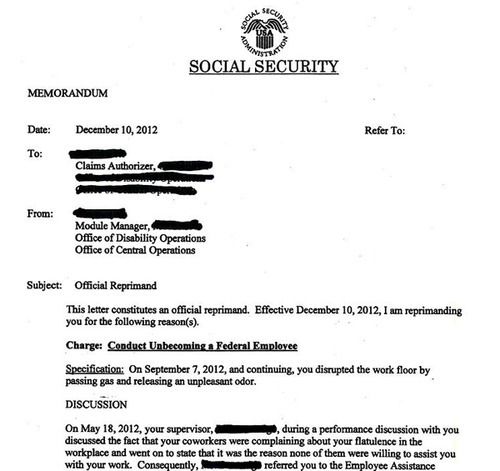
A redacted copy of the SSA flatulence reprimand letter was posted to The Smoking Gun website.

By Ben Popken, TODAY contributor
It sounds like a "Dilbert" cartoon come to life, but the Social Security Administration has taken back a reprimand it gave to an employee who was written up for "passing gas and releasing an unpleasant odor" that created a "hostile work environment."

The official charge was "Conduct unbecoming a Federal employee." More specifically, "On September 7, 2012, and continuing, you disrupted the work floor by passing gas and releasing an unpleasant odor."

A copy of the letter, along with a picture of the employee at an amusement park standing next to an actor in a Pepe Le Pew costume, was published on TheSmokingGun.com.

The letter included a timestamped log accurate to the minute, documenting 60 separate-gas passing incidents from the employee in his office in three months, or about 9 per day.

The average person passes gas 14 times per day.

Medical conditions such as Crohn's disease, irritable bowel syndrome, and lactose intolerance, can cause sufferers to have chronic gas problems. The employee told management he was lactose intolerant.

"You have submitted medical evidence that you have some medical conditions," the letter read, "however, nothing that you have submitted has indicated that you would have uncontrollable flatulence. It is my belief that you can control this condition."

Several of the employee's coworkers in the "module," or work area, had complained to management about the smell. A supervisor, Deputy Division Director and a Module Manager all spoke with the employee on separate occasions about his need to control his flatulence.

"You said that you would try to pass gas and that you would turn your fan on when it happens," the Module Manager wrote of a discussion that took place on May 18, 2012. "I explained to you that turning on the fan would cause the smell to spread and worsen the air quality in the module."

On August 14th the employee promised to purchase "Gas X" in order to limit his gas output.

Another incident, dated August 15th, noted "you have continued to release the odor and it has become intolerable to work in the module creating a hostile work environment for all your coworkers."

The letter quoted guidelines from the "Annual Personnel Reminder" and "2012 SSA/AFGE National Agreement" which the Module Manager claimed the employee had violated, including "courtesy and consideration while dealing with coworkers" and "refrain from coercive, intimidating, loud or abusive behavior."

If the "misconduct" was continued after the reprimand letter, it could lead to "more severe disciplinary action...including, removal from federal service."

Reached for comment, SSA spokesperson Mark Hinkle told TODAY, "A reprimand was issued to the employee; however, when senior management became aware of the reprimand it was rescinded on December 17, 2012. The agency cannot comment further due to privacy concerns. "

Saturday, January 19

Landing a dream job, take a little risk

Landing a dream job, take a little risk

Anne Hathaway says playing Fantine in the current release of “Les Miserables” was her dream job despite having to lose weight and chop off her hair to portray the tragic heroine.

But you don’t have to star in a box office smash to have your best-ever job, even in the theater business.

Ask Rickae Boyd. The 48-year-old landed the job of her dreams last summer when she became executive director of a community theater in Searcy, Ark., population 20,000. Boyd’s love affair with theater started in third grade. But after graduating from college with degrees in drama and English, she got sidetracked managing apartment complexes, content to make theater a hobby instead of a career. It was that management experience that finally got her hired to run Searcy’s Performing Arts Center on the Square after years of volunteering there and serving on the group’s board.

Now on a typical day, Boyd may wash tablecloths in the morning, run a children’s drama workshop in the afternoon, and in the evening, direct “One Flew over the Cuckoo’s Nest,” “A Christmas Carol,” or another of the handful of plays the theater stages a year. “It’s amazing to be here,” she says. “We’re nonprofit, so it pays buttons. But it’s worth it because it’s something I enjoy.”

Work that plays to your natural strengths and feeds your soul is just part of what constitutes a modern-day dream job, according to workplace experts and career coaches.

Other factors include feeling like you’re giving back or making a difference in the world, working for an employer that values what you do, and having the flexibility to balance work with the needs of family or outside interests, according to the experts.

What would it take to make your job a dream job?

“You have to know your needs,” says Kathy Caprino, a Wilton, Conn., career coach. “You have to know your financial needs, your style of working, your preferences and standard of integrity, the things that are non-negotiable.”

An unexpected perfect fit
While people like Boyd work for decades before finding their life’s calling, others stumble onto it. Jake Timmons is one. Like lots of little kids, Timmons, 22, grew up playing with wooden trains sets. But he never anticipated a railroad career.

He changed his mind after interning with BNSF Railway Co. while studying mechanical engineering at the University of Colorado at Boulder. Timmons worked for BNSF during summer 2011, helping redesign an airbrake maintenance facility in Lincoln, Neb. That fall, BNSF offered to hire him into a management trainee program after his May 2012 graduation. It didn’t sound as glamorous as offers he and his engineering buddies got from aerospace and satellite companies. But Timmons had fun during his internship, and the management training job paid $65,000 a year, plus benefits. So he accepted.

The job was a perfect fit. Timmons uses his technical background to supervise railroad workers at the same Lincoln facility where he interned. He doesn’t mind the nine-and-a-half-hour days or alternating between day, swing and night shifts. “I’m running around the shop all day long helping people get their jobs done,” he says. “It turned into my dream job after I realized that I really enjoy doing what I’m doing, talking to people and seeing a problem” and fixing it.

It didn’t hurt that even before he started, BNSF boosted Timmons’ salary -- twice -- to keep the pay competitive with comparable jobs. He says it’s one of the perks of working for a company owned by Warren Buffett’s investment company, Berkshire Hathaway, Inc. “All the employees I talk to say the railroad treats their employees really well,” he says.

Risking it all for a dream
Feeling valued and being well compensated are important components of a dream job, career experts say. Even if you like your job, it might not be enough to make up for a bad office vibe, mean boss or pay that’s not equal to what you’re worth. “Often times, people leave the company rather than the job,” says Robert Levering, co-founder of Great Places to Work Institute, a nonprofit that researches superior workplaces. “They’ll leave a company because there is some problem there. They get another job that’s the same job but in a different environment.”

Natalee Binkholder knows what it means to like what you do but not where you’re doing it. In 2007, Binkholder graduated from law school in Missouri and moved to Reno, Nevada, for a job with a nonpartisan state agency that helps lawmakers draft bills. She loved writing new laws, but not the 90-hour work weeks, the people or being so far away from her Midwest-based family.

After three years, Binkholder was ready to bolt. She scoped out opportunities in a few cities before deciding Washington, D.C., was the place to be. She quit her job, found a short-term rental near Capitol Hill, threw her belongings in the car and drove across the country. Arriving in July 2011, Binkholder “made applying for a job my job,” she says. Two months into her search, she answered a blind ad that ultimately led to a position doing the bill-writing work she loves as legislative counsel with Rep. Mick Mulvaney, R-S.C. Since then, she’s been promoted to legislative director and counsel. “I’m amazed at how well policy work fits me,” she says. “I never imagined I’d be doing this, but now I can’t imagine doing anything else.”

To find your dream job, you have to be able to take a risk, Binkholder says. “I’m a good example of it working out. If I hadn’t taken the risk of moving across the country and spending my savings, it never would have happened.”

Taking the bad with the good
Even dream jobs have their trying moments. Nicki Boyd picks up poop -- not that she minds. Boyd, 42, is the San Diego Zoo’s behavior husbandry manager. In her position, examining animals’ fecal matter to see whether or not they’re healthy comes with the territory.

Most of Boyd’s interactions with zoo animals aren’t so unpleasant. She walks the cheetah, trains polar bears and grizzly bears, and works with birds and reptiles, too. Since being promoted three years ago, she spends more time managing zoo employees than interacting with the animals. Still, she loves what she does. “I like doing both,” says Boyd, who earned three degrees, interned and volunteered to get to where she is today. “Animals don’t talk back to you, but they also can’t tell you what they’re thinking or feeling. You have to have that intuition to work with animals. But really to be successful, you have to be able to work with both.”

Flexibility and work/life balance
Balancing work, family and whatever else life tosses your way is a bigger part of people’s dream jobs than it used to be.

Ilana Bergen doesn’t train wild animals, direct plays or work on Capitol Hill. But she’s in her dream job just the same. The 30-something Seattle woman works as a contract content strategist, creating online campaigns -- she calls them “branded entertainment experiences” -- for companies such as Johnson & Johnson and Microsoft. For Bergen, who previously ran her own online marketing agency, it’s a job that feeds her creativity and business side. “I get to work for big businesses but still have that entrepreneurial feel,” she says.

Friday, January 18

Why is bored at work is not such a terrible thing

Not painstakingly read workplace associations such as reports or sit through a fear - they make you more productive.

Boring, monotonous tasks help you be a better problem-solver, new research finds, because our brain, which use "die Zeit" unstimulating to branch out and think in more creative ways.

"Boredom had always such bad press, but some boredom is possibly good... especially if it gives us the opportunity to dream," Sandi said man, senior psychology senior lecturer of the University of Central Lancashire in the U.K.-man research was presented this week at the annual Conference of the British Psychological Society Division of occupational psychology.

"Able to have that time when you unleash your thoughts, can be great creativity," said the man.

Americans are getting 2010 total less creative according to a study of the landmark. Kyung-Hee Kim, an associate professor at the College of William & Mary's education, analyzed results of creativity tests and determined that our creativity on the wane included, has been for more than 20 years, although IQ scores climbing.

Experts say one reason for our collective lack of creativity we get increased stimulation is in our daily lives: we see Netflix while we wait on the bus and play angry birds when we stuck in a line at the cashier.

No one may be boring, but it is a State of mind which we not so quickly be eliminated. The reason why the we is bored, that our brain said not enough neural stimulation, man, and attempt is daydreaming of the spirit, self-stimulate.

Topics in Mann's experiments, which have been assigned to, boring tasks such as E.g. read or copy phone book entries, developed more on a subsequent creative task--come with so many different uses of two styrofoam coffee cups as they could - as in a control group.

Man found more than something boring to write something boring increased creativity, reading. You the theory, that lent the passive nature of reading itself better to daydreaming.

"As soon as we are allowed to dream, our minds are free, who think differently," said man, which leads to creative problem solving.

But your boss could not see it. "At work, daydreaming positively, not applies," said executive coach Lisa Garcia Jacobson. Not stare into space at meetings or otherwise visible your boredom shows. "[They] must they practice in a targeted way", said Jacobson.

When you resolve a problem at work try to spend some time on a task, that do not require much concentration, the audiobook on your ride home drive or a short walk (and leave the Smartphone) a cognitive blockade to relieve man suggested. "In any case", if you are looking for a solution for something which even the possibility that your soul a little dangle probably helps, she said.

Another thing that could bring you more quickly to a solution: Cut the multitasking, Jacobson said. Studies have shown that if you try to focus on too many things at the same time they all get the short shrift.

Concentration on the task, even if it do, is a better alternative. You'll work more effectively, and should begin a part of your mind to wander, the key to the solution of your next work could challenge these unwritten thoughts.

Thursday, January 17

Career advice for Miss Alabama United States

Career advice for Miss Alabama United States

Two days after the BCS Championship, was the largest history, Alabama's win from the game, but remarks about Alabama quarterback A.J. McCarron watched girlfriend like them from the stands. Katherine Webb, Miss Alabama United States is 2012, talks about her overnight fame, say she is not offended and says that people "unfair", the commentators have been.

Katherine Webb achieved Internet fame in a roundabout, unpleasant way, but career coaches say that the incident could push the beauty queen on bigger and better ventures.

College football arouses passions, but usually not the kind of Brent Musburger expressed when he about Webb's appearance on Monday evening during the University of Alabama victory in the BCS title game poetic waxed.

For Webb, Miss Alabama United States 2012 and girlfriend of Alabama quarterback a.j.. McCarron more than 254,000 of slightly more than 2,000 turned the attention and a subsequent apology from ESPN for Musburgers comments in a social-media blowout with their twitter followers spiking.

Webb could easily use it over night fame as a springboard for celebrity status, and it would not be the first. 'Baywatch' Star Pamela Anderson was in 1989 while one discovered Vancouver, BC Lions football game, as a camera scanning the crowd the Jumbotron you are projecting. Other fans reaction, as well as their luck selection of a Labatt T-shirt she landed a gig as a spokesmodel for the beer and the rest is history.

Webb sure questions "What wants to create it?" said Elene Cafasso, founder and President of executive coaching firm Enerpace. "She wants this in their own business parlay?"

Webb has received at least an offer. Donald Trump tweeted, "we are Katherine Webb judges at the Miss United States pageant coming in Las Vegas to ask."

In an interview with the today's Matt Lauer on Wednesday, Webb said she was "flattered" by Musburger the comments and find them not derogatory, but she seemed eager to deflect the spotlight. "I'm really honestly shocked," she said. "We need our attention, the Alabama football team know who are the true winners to pull back, and has that."

"This is not surprising, even if you attention, how", said James Bailey, psychologist and Professor of leadership at the George Washington University. "It could be a little overwhelming", this type receive from social media fed notoriety, especially since Webb had no control over the situation.

So far, said Bailey Webb displayed a measured response to the hype and was likely to find out, what to do next.

Career coach Brenda Griffin agreed. "It came from the nothing. It was just a football game, "she said. "I think what makes them even more prepared."

At 23, Webb is due to their participation in pageant in public is familiar, and that could be an asset, you associate psychology professor C. Randall Colvin after an article about night fame written by Northeastern University. "People a pos­sess formed and mature iDEN­tity are less likely that suc­cumb the pit­falls of glory and fame instead others could use for the benefit," he said.

"Good to do for others my goal for all this media madness..." tweeted Webb.

Webb Trump in his offer could take on and more will be awarded in the world or they could lend their fame to Alabama's football program. "I'll do what I can to help the team and support a.j..," she told Lauer. Griffin, said Webb could her Twitter fame into a platform for promoting a cause or parlay interests close to their heart, or they could use the interactivity of the Internet as a kind of litmus test.

"A good way is to tweet about different topics and see, what answers you get," defeated Griffin. "You can measure to see commitment, what people are really interested in."

Wednesday, January 16

Wall Street edges from 5-year highs, is the result of

Wall Street edges from 5-year highs, is the result of

Reuters
Shares ground lost on Monday, as investors back from the recent gains, which moved the S & P 500 to a five-year high in anticipation of sluggish growth of corporate earnings lifted.

Shares dipped by financial companies, after a group of U.S. banks agreed figures total $8.5 billion, an investigation of the failed mortgage foreclosures Government to quit. The KBW Bank index, an indicator for the U.S. bank stocks was 0.3 percent.

Other sectors were especially energy and utilities, affected. Energy sector index, the S & P 500 fell 0.8 percent and utilities sector was off 1.1 percent.

Decline of the day came in a session after the S & P 500 ended a five-year-high, reinforced by a budget and strong economic data. The S & P 500 rose 4.6 percent last week, win the best weekly in more than a year.

"It's a little bit of some risk off the table prior to winning season, you will not see what that great" on the result, said Larry Peruzzi, senior equity trader at Cabrera capital markets Inc. in Boston.

The results are expected to be only slightly better than lackluster results in the third quarter and current estimates of the analysts are down sharply, where they were in October. Earnings growth in the fourth quarter is expected to be 2.8 percent, are based on data from Thomson Reuters.

Alcoa Inc. aluminum company begins reporting season with the announcement of its results after market close on Tuesday. Alcoa shares fell to $9.10-1.7 percent.

The Dow Jones industrial average fell 50.92 points, or 0.38 percent, to 13,384.29. The standard & poor's 500 index fell 4.58 points, or 0.31 percent, to 1,461.89. The Nasdaq composite index lost 2.84 points or 0.09 percent to 3,098.81.

A review of the case of foreclosures, which stop US regulators demanded ten Mortgage Servicers - including Bank of America, JPMorgan, Citigroup and Wells Fargo-$8.5 billion agreed on Monday figures.

In a separate case Bank announced BofA also about $11.6-billion settlement with finance mortgage company Fannie Mae and a $1.8 billion sale of the collection rights for home loans.

The Bank also appeared in agreements with nation star mortgage holdings and Walter investment management, approximately 306 billion $ of mortgage loans to sell servicing rights.

Bank of America shares lost 0.2 per cent to $12.09, during nation star mortgage holdings jumped 16.8 percent to $38.83.

Citigroup shares rose 0.09 percent to $42.47 and Wells Fargo shares fell 0.5 percent to $34,77.

"Financials probably the wind behind them now come with a lot of regulations... the market has to absorb much of the profits and for the reason there is a retreat from this level", said Warren West, principal at Greentree brokerage services in Philadelphia.

Shares of U.S. Jet maker, which Boeing Co fell 2 percent after a plane of Boeing 787 Dreamliner with no passengers on board the from Boston Logan International Airport on Monday morning caught fire.

Amazon.com shares hit is their highest price ever at $269.22 after Morgan Stanley raised the rating on the stock. Shares rose 3.6 percent to $268.46.

Video-streaming service Netflix Inc shares 3.4 per cent to $99.20 won after it said that there are some past seasons popular shows from time Warner Warner of Bros. television produced will help.

Walt Disney Co shares fell 2.3 percent to $50.97. The company began an internal review of the cost-cutting a few weeks ago can contain the layoffs at his Studio and other units, three people with knowledge of the effort told of Reuters.

Volume was lower than average, such as 4.78 billion shares on the New York Stock Exchange, traded MKT NYSE and NASDAQ. This is far below the average 2012 from 6.42 billion per session.

Declining stocks outnumbered advancing ones on the NYSE by 1.629, 1.363, while on the NASDAQ Decliners commit 1.438, 1,066 beat.

Tuesday, January 15

Banks $8 total annual sales reach settlement on mortgage abuse

John W. Schoen, NBC News

Ten of the largest U.S. mortgage lenders have $8.5 billion to a settlement with federal authorities, the a case of review programme to identify the victims of abuse widespread foreclosure end agreed.

With the latest multi billion-dollar settlement, giant of the country mortgage lenders that mortgage confusion behind hope. But critics of the deal worry that it may leave millions of foreclosed homeowners that little or no relief from lenders, that confusion created the mortgage in the first place.

"I have serious concerns that this settlement banks to rock, what it debt and go past abuses under the rug without determining that the borrower have suffered the full damage may allow", Rep said Elijah E. Cummings, d-MD., Member of the House Committee on oversight and democratic Government and a voice, which critically about the Government controller handling the mortgage crisis.

OCC officials said on Monday that consumers are better served under the settlement, because claims are now faster, and that diversion of funds that will be used was can the cost of the review process to pay claims. By reviews from case to case, already more than 1.5 billion $ has spent, officials said.

"We started independent review of foreclosure, said OCC to fix what was broken, who was harmed as they compensate for the injuries to recognize," said Thomas Curry Comptroller in a statement the currency. "While today's announcement represents a significant change in direction, it meets the original objectives by ensuring that are the consumers, who will benefit and they benefit from a faster and more direct way."

In accordance with the agreement of banking giant six other mortgage lenders, JPMorgan Chase, Bank of America, Citigroup and Wells Fargo $5.2 billion in aid, mortgage and $3.3 billion direct payments wrongly borrowers, will offer according to the Office of the Comptroller of the currency and the Federal Reserve.

The other seven lenders include Aurora, MetLife Bank, PNC, SunTrust and sovereign and US Bank.

Banks were among the 12 lenders and two mortgage service companies, cited by regulatory authorities in 2011 for the foreclosure who claims widespread abuse after that she improperly foreclosure had confiscated houses in the wave of registrations, which flooded after 2007 housing reduce the industry.

OCC officials said that 10 lenders have approved the settlement in principle, but the terms are not disclosed until they are completed. They said that continued discussions with other institutions ordered to review foreclosures, bank containing EverBank, OneWest, HSBC and sovereign.

When industry-wide foreclosure abuse almost two years ago surfaced, required to contact federal banking regulators, banks and service companies, consulting firms borrowers and check their cases to rent. Some 4.4 million letters were sent to potential applicants, applied 31 December within the period have reviewed their cases of which around half a million.

Consumer groups are working, to head off foreclosures, the review programme from the outset, have partly criticized as the consulting firms, carrying out the reviews and quotes from financial institutions for unlawful practices. Since then critics have called slow progress in the review of cases and compensate the victims of wrongful foreclosure.

Federal authorities said in June that the lender, the implementation of reviews would have to more than $125,000 debtors to pay their Hauser wrongly seized. But so far no borrowers have been paid, according to regulators.

Critics of Monday's settlement argued that there will be many wrong homeowners with no other recourse left, that significantly the amount lenders reduced ultimately have to pay it.

"For many people the end of the line", said Diane Thompson, a lawyer with the National Consumer Law Center. "This is a much lower number for banks in comparison compared to what they at risk for were."

Monday, January 14

Service industry picked up the pace as 2012 ended

Reuters

The vast U.S. services sector grew at its fastest clip in 10 months in December, boosted by a rise in new orders, according to an industry report released on Friday.

The Institute for Supply Management said its services index rose to 56.1 last month from 54.7 in November. The December reading was the highest since February and was well above economists' forecasts of 54.2, according to a Reuters poll.

A reading above 50 indicates expansion in the sector.

New orders rose for a second straight month, with the sub-index hitting a 10-month high of 59.3 in December after 58.1 the prior month. Hiring in the sector also picked up, with the employment index jumping to 56.3 - the highest since March - from 50.3 in November.

U.S. government bonds slipped after the stronger-than-expected report while Wall Street held slight gains seen after a separate report showed the economy added 155,000 jobs last month, close to estimates by economists.

"Overall a good number, especially when combined with the wage improvement in the jobs report," said Joseph Trevisani, chief market strategist at WorldWideMarkets in Woodcliff Lake, New Jersey.

Sunday, January 13

Economy created modest amount of jobs in Dec.

Patrick Rizzo and John Schoen

Employers last month shrugged off worries about the high-profile budget battle in Washington and continued hiring at a slow, steady pace, government data showed Friday.

“(The job market) has been very resilient to a lot of the uncertainty that people have been talking about,” said Jared Bernstein, a senior fellow at the Center on Budget and Policy Priorities and former economic adviser to Vice President Joseph Biden. “This is an okay job report at a time when you might have expected something worse.”

But the pool of workers looking for a job remains nearly twice as big as it was before the 2007 recession began to take hold.

The Labor Department reported Friday that payrolls, rose by 155,000 in December. That’s just about fast enough to keep pace with the growth of the population, but not enough to make a dent in the unemployment rate, which remained stuck at 7.8 percent last month.

“This has been the story throughout the recovery that began more than three years ago,” said Paul Ashworth, chief U.S. economist at Capitol Economics.

The number of unemployed Americans last month was essentially unchanged, at 12.2 million. That’s down from a peak of 15.4 million in October, 2009, but much higher than the 6.7 million who were out of work in March 2007.

The job gains last month were spread over a broad segment of the economy, from construction to manufacturing to health care.

Economists say the breadth of jobs gains is a good indication that the slow but steady recovery remains on track. But most forecasters expect the lackluster pace of growth – about two percent as measured by the gross domestic product – to continue through 2013.

Wage growth also remained flat, after adjusting for inflation, as it has since the recovery began. That trend runs counter to past economic rebounds, when wages have traditionally risen as the unemployment rate has fallen, according to Wells Fargo chief economist John Silvia.

“(That) supports the message of weaker consumer spending and GDP growth ahead,” he said

While the political spectacle of a dysfunctional government seems have had little impact on December hiring, the results of the budget battle are expected to have at least some dampening effect on hiring. Government spending, a critical target in the ongoing debate, makes up roughly 20 percent of U.S. economic activity.

Friday’s numbers demonstrated the impact of the ongoing budget squeeze on the job market. In December, government at all levels cut 13,000 jobs. For all of 2012, government payrolls shrank by 68,000.

While the December jobless rate was nearly a percentage point lower than a year ago, it’s still well above the average over the last 60 years of about 6 percent. The drop has also come as millions of workers have given up trying to find work. As a result, the portion of the population officially counted in the labor force is at the lowest level in three decades.

The pool of “long-term” jobless workers – those without a paycheck for 27 weeks or more – remained unchanged in December at 4.8 million, or nearly 40 percent of the unemployed.

That high level of persistent unemployment prompted the Federal Reserve to embark on its latest, open-ended round of bond buying in September to force interest rates lower and help spur hiring. The central bank has kept interest rates near zero since 2008. On Thursday, however, minutes from the Fed's December meeting suggested that some policymakers were growing more concerned about the impact of that policy on the financial markets.

Friday’s lackluster job data will likely help support proponents of the Fed’s continued easy-money policy, said Ashworth.

“If this state of affairs continues throughout most of this year, as we expect, then it is hard to see the Fed dialing back or stopping its (bond) purchases as some officials currently envisage,” he said.

The December report included a number of revisions, in part due to annual tweaks in the adjustments the Labor Department uses to smooth out seasonal swings in hiring. The government raised its estimate for the unemployment rate in November by a tenth of a point to 7.8 percent. The payroll number for November was also raised to 161,000 new jobs, from 146,000.

Saturday, January 12

Fed concerned about stimulus side effects

Fed concerned about stimulus side effects

WASHINGTON -- Federal Reserve officials are increasingly concerned about the potential risks of the U.S. central bank's asset purchases on financial markets, but look set to continue its open-ended stimulus program for now.

Minutes from the Fed's December policy meeting showed a growing reticence about further increases in the central bank's $2.9 trillion balance sheet, which it expanded sharply in response to the financial crisis and recession of 2007-2009.

"Several (officials) thought that it would probably be appropriate to slow or to stop purchases well before the end of 2013, citing concerns about financial stability or the size of the balance sheet," the minutes said.

Wall Street picked up on the report's hawkish tone, with stock prices drifting lower after the announcement, while the dollar extended gains against the euro.

"The minutes of the Federal Reserve's December monetary policy meeting revealed a somewhat surprising level of concern among the ranks of central bankers regarding the long-term impact of the bank's asset purchase program, or quantitative easing," said Omer Esiner, chief market analyst at Commonwealth Foreign Exchange in Washington D.C.

Still, the Fed appeared likely to continue buying assets for the foreseeable future, having announced in December it was extending monthly purchases of $40 billion in mortgage securities and also buying $45 billion in Treasuries each month.

A few of the voting members on the central bank's policy-setting Federal Open Market Committee thought asset buying would be warranted until about the end of 2013. A few others highlighted the need for further large-scale stimulus but did not specify an amount or time frame.

Fed officials generally agreed that the labor market outlook was not likely to improve without further nudging from the monetary authorities.

The U.S. economy expanded a respectable 3.1 percent in the third quarter on an annualized basis, but growth is believed to have slowed sharply to barely above 1 percent in the last three months of the year.

Data on Thursday showed a solid gain of 215,000 new private sector jobs for December, while analysts polled by Reuters last week were looking for a rise of 150,000 new jobs in the Labor Department's official survey, due out on Friday.

In the December meeting, the Fed also launched a new framework of policy thresholds, numerical guideposts that are supposed to give markets and the public a clearer idea of how policymakers will react to incoming economic data.

Officials say they will keep interest rates near zero until the unemployment rate falls to 6.5 percent for as long as estimates of medium-run inflation do not exceed 2.5 percent.

The minutes suggested it took officials some time to build a consensus around the idea.

"A few participants expressed a preference for using a qualitative description of the economic indicators influencing the Committee's thinking," the minutes said.

U.S. unemployment has come down steadily after hitting a peak of 10 percent in late 2009, but remains elevated at 7.7 percent.

Fed officials noted worries about the looming "fiscal cliff," which was dealt with only partly in an agreement earlier this week, were hurting the confidence of businesses and households.

Friday, January 11

Businesses added 215,000 jobs in Dec.

Businesses added 215,000 jobs in Dec.

NBC News staff and wire reports

The jobs picture looked a bit brighter Thursday after two pieces of data showed businesses picked up hiring and cut back on layoffs in December.

U.S. private-sector employers added 215,000 jobs last month, well above economists' expectations, a report by payrolls processor ADP showed. And planned layoffs dropped for the first time in four months, according to a separate report from consultants Challenger, Gray & Christmas, Inc.

Jobless claims bucked the trend by rising in the latest week, but the data was distorted by the holidays.

"All the labor market data….has held up very, very well so (there is) no sign of the fiscal cliff impact on the job market," said Mark Zandi, chief economist at Moody's Analytics.

Economists surveyed by Reuters had forecast the ADP National Employment Report would show a gain of 133,000 jobs.

November's private payrolls were revised upward to show a gain of 148,000 from the previously reported 118,000.

The report is jointly developed with Moody's Analytics.

Separately, employers announced 32,556 job cuts last month, the second lowest monthly total of 2012 and down 43 percent from 57,081 in November, according to the report from Challenger. In 2012, the only month with a lower job-cuts tally was August, with 32,239.

December's job cuts were also down 22 percent from the 41,785 seen a year ago.

During 2012, employers announced 523,362 cuts, down 14 percent from the 606,082 job cuts announced in 2011 and the lowest level since 1997 when employers announced 434,350 cuts.

"We saw a few spikes in monthly job cuts in 2012 and there were some significant mass layoffs that definitely reminded us that not every industry is enjoying the fruits of recovery. However, the overall pace of downsizing was at its slowest since the end of the recession," said John A. Challenger, chief executive officer of Challenger, Gray & Christmas.

"In fact, we have not seen this level of job cutting since before the dot-com collapse and subsequent 2001 recession," Challenger said in a statement.

The Labor Department said initial claims for state unemployment benefits increased 10,000 to a seasonally adjusted 372,000. The prior week's figure was revised to show 12,000 more applications than previously reported.

Claims data reported for the week ended December 22 had been artificially depressed by the holidays, which resulted in data for 19 states being estimated.

The four-week moving average for new claims, a better measure of labor market trends, rose 250 to 360,000. The claims data has no bearing on December's employment report, scheduled for release on Friday.

Employers are expected to have added 150,000 jobs to their payrolls last month, little changed from 146,000 in November, according to a Reuters survey of economists.

Reuters contributed to this report.

Thursday, January 10

Economy poised to grow, once DC gets out of the way

Economy poised to grow, once DC gets out of the way

John W. Schoen , NBC News

If the ongoing political dysfunction in Washington is weighing on the U.S. economy, someone forgot to tell Philip Derrow.

The second-generation CEO of Columbus, Ohio-based Ohio Transmission Corp., just closed his company’s 2012 books with 15 percent revenue growth for the year and a 10 percent expansion of the company's payroll. Derrow said he’s looking forward to a strong 2013.

"The talk in the media is harmful, the absence of leadership in our political class is harmful, but business leaders have an obligation to find a path forward," he told NBC News. "Sitting on your hands is how you lose. And losing is not an option."

Despite widespread, dire warnings that the ongoing budget stalemate threatens to send the U.S. back into recession, recent underlying economic data tell a different story.

The latest came from payroll processor ADP, which said U.S. private-sector employers added 215,000 jobs last month, well above economists' expectations. A separate report on planned layoffs showed the first drop in four months, according to employment consultants Challenger, Gray & Christmas, Inc.

"All the labor market data - the payroll numbers the jobless claims every else - have held up very, very well,” said Mark Zandi, chief economist at Moody's Analytics. “So there’s no sign of the fiscal cliff on the job market."

The improvement in the job market echoes signs of strength in the housing and auto industries. Despite the ongoing recession in Europe, manufacturers closed out the year on an upswing. Although retailers reported lackluster holiday sales, consumers have sharply pared down debt and built up savings, all of which bodes well for 2013.

Despite multiple pressures weighing on growth, the U.S. economy’s normal state is expansion. Beyond the underlying demand created by population growth, households continue to strive to build wealth and businesses remain bent on increasing profits.

As obstacles are removed – including the uncertainty over tax policy that was partially removed by the New Year’s fiscal cliff deal – those underlying forces have a better chance of taking hold.

Investors staging a New Year's rally in the stock market seemed to be betting that may happen in 2013.

"The underlying economy has momentum, and the employment data confirms that," said John Brady, a managing director at the investment firm R.J. O'Brien & Associates in Chicago. "The hope and prayer of the market is that our political leaders don't screw it up."

There are plenty of ways Washington could continue to hold back the U.S. economy. The most pressing is the possible repeat of the debt ceiling spectacle that produced the fiscal cliff in the first place, after lawmakers brought the country to the brink of a self-inflicted Treasury default in July 2011. The political “solution” was the creation of a fiscal cliff time bomb that has yet to be fully defused.

The ruinous, automatic spending cuts called for in that strategy are still in force; the recent deal just delayed them for two months. With government spending fueling about 20 percent of the U.S. economy, deep cuts could quickly derail growth coming from households and businesses.

Business investment has also been weak due in large part to the ongoing debate about the thicket of corporate taxes, including a series of temporary incentives to try to spur growth. Ironically, those measures may have added to the uncertainty that has prompted companies to hoard cash.

Derrow cites the government’s 2009 “cash for clunkers” program that produced a surge in car buying that summer, followed by a sales hangover once the incentives were exhausted. Short-term incentives designed to spur companies to buy new equipment and vehicles have made it harder to set long-term plans for investing capital, he said.

“Many if not most businesses have money to spend,” he said. “The problem is that policymakers for the past four years have made that spending very unpalatable."

But four years into the weakest recovery in a half century, pent-up demand is helping to overcome those hurdles to investment. After the worst contraction since the Great Depression the housing market is showing convincing signs of recovery.

Contracts to buy previously-owned U.S. homes rose in November to their highest level in 2-1/2 years, an industry group said last week. Though some local markets remain under pressure, home prices in most parts of the country are rising again.

That's good for the construction industry, according to Zandi. “I think we’re on the leading edge of a lot of construction jobs,” he said. “We are going to see a lot more homes built and a lot more office towers built over the next couple, three, four years. And so I think we’re going to see a lot of construction and construction-related jobs.”

The U.S. auto industry is also coming off a strong 2012 and expects higher sales in 2013. A new study by R.L. Polk forecasts 15.3 million new vehicle registrations in the U.S. this year – up 6 to 7 percent from the anticipated final sales numbers for 2012 and a roughly 50 percent increase from the bottom of the automotive market collapse during the recession.

American households, meanwhile, are making slow, steady progress in rebuilding the wealth lost to the housing and financial collapse. Much of the improvement has been the result of the Federal Reserve’s relentless, easy-money policy to drive down borrowing rates.

The savings on monthly mortgage and credit card payments have helped consumers work off the financial hangover of an epic, mid-2000s borrowing binge Though millions of homeowners remain underwater on their mortgages, the overall ratio between debt and disposable income fell to a near-decade low of 113 percent in the third quarter, after peaking at 134 percent in mid-2007, according to the latest Federal Reserve data. Even as wages have stalled, households’ overall net worth hit a four-year high in the third quarter of more than five times annual disposable income.

U.S. banks have also recovered from the heavy, self-inflicted losses brought on by risky bets on mortgage bonds that went bust. Though lending remains tight for all but the most credit-worthy borrowers, the banking system is better able to withstand the kind of financial shock that plunged the global economy into a steep recession more than five years ago.

For businesses like Ohio Transmission, there will always be potential landmines and obstacles to growth. But, after 30 years running the company, Derrow said that’s nothing new.

“The natural state of the American economy is for things to get better,” he said. “As business leaders, we make promises to our people that we'll find a positive way forward. That’s our job. That’s part of what makes business fun.”

Wednesday, January 9

How the fiscal cliff deal will hit your taxes

John W. Schoen , NBC News

Yes, your taxes are going up. But you dodged a much bigger bullet.

Those increases are relatively modest compared to what the fiscal cliff would have imposed, however.The last-minute ‘fiscal cliff’ deal to reverse Congress’ ruinous, self-inflicted package of federal tax increases and spending cuts will raise the average American household’s tax bill by $1,250 this year, or about $25 a week.


For most Americans, the biggest impact will come from the expiration of a two-year payroll tax “holiday” enacted two years ago to boost the economy. That tax break amounted to two percent of wages.

“For a lot of people the increased withholding from payroll tax expiration will be significant and they’ll really see that and feel that as a legitimate tax increase,” said Joseph Rosenberg, an analyst at the Tax Policy Center. “But there was a lot of tax relief that has been extended."

Without a deal, taxes would have jumped by more than $500 billion in 2013 as almost every tax cut enacted since 2001 was set to expire. That would have cost the average household almost $3,500 per year, or about $67 a week, according to the Tax Policy Center.

The deal hammered out in the waning days of 2012 preserves most of those tax cuts – except on the very top of the income ladder. Even then, the final deal raised the definition of “wealthy” from $250,000 for couples ($200,000 for individuals) to $450,000 for couples ($400,000 for individuals). Those thresholds also apply to many small businesses that pay taxes at individual rates.

The averages, though, apply to a statistically tiny group of people who fall in the middle of every variable in the new law. Thanks to dozens of provisions that will hit different households making the same income in different ways, your overall tax bill will almost certainly change by more – or less – than $25 a week.

You won’t really know until you fill out your 2013 tax return a year from now. But here are some of the ways your tax bill may change:

PAYROLL TAXES: The most immediate, and visible impact will be a relatively small increase (about two percent of your wages) that will come out of your first paycheck of the year. You’ll keep paying that “extra” tax until you’ve reached the wage limit subject to the tax, which this year rises to $113,700. (This tax shows up in the FICA line on your paycheck.) If you hit that limit before the end of the year, you stop paying the tax.

Though you’re paying more than last year, your payroll tax rate is now back to where it was in 2009, before Congress and the White House cut the tax to help boost the economy. That measure added about $20 a month to the average household’s spending power. Now, the government wants that money back to help close the deficit.

INCOME TAXES: Though taxes are going up a bit, all but the wealthiest households dodged the biggest fiscal cliff tax bullet: the expiration of the Bush-era tax cuts. Many economists feared that if those cuts were reversed all at once, the resulting dramatic tax increases would have siphoned off billions of dollars in consumer spending that would have sent the U.S. economy back into recession.

The new law left income tax rates alone, except for the new top bracket above $400,000 for individuals ($450,000 for couples) who will now pay 39.6 percent on every dollar over that amount, up from the current 35 percent. (They’ll pay the lower rates on money earned in lower brackets, just like everyone else.)

CREDITS AND DEDUCTIONS: Some upper-income households will also pay more because they’ll lose some of their tax breaks on itemized deductions for things like mortgage interest. Those will now be capped for individuals making more than $250,000 (couples more than $300,000.) They’ll also see their $3,800 personal exemption – the tax break everyone gets – phased out.

Parents will get to keep a $1,000 child tax credit that had been set to drop to $500. The new law also reversed a $600 cut in the $3,000 credit for child and dependent care that was due to take effect. Parents will continue to get the up-to-$2,500 tax credit for college tuition that was set to be cut.

CAPITAL GAINS, DIVIDENDS: Money you earn from capital gains or dividends on investments will still be taxed at 15 percent – unless your total income is more than $400,000 for individuals ($450,000 for couples. Those in the top bracket will now pay 20 percent – up from 15 percent.

Dividends and gains on investments held in a qualified account like a 401(k) will still be deferred until you withdraw the money when you retire. The new law also preserved increased limits for how much you can contribute tax-free.

ALTERNATIVE MINIMUM TAX: This stealth tax monster, which had threatened some 28 million unsuspecting households in 2013, has been permanently killed. Originally designed as a separate set of rules to close tax loopholes for “wealthy” families, the law’s architects forgot to take inflation into account, pushing more and more middle-income households into its path every year.

For years, Congress has “patched” the law at the last minute to save its new victims from an average $3,000 tax bump. The process also overstated how much the government collected because “official” estimates assumed it would be collected.

The new law makes that patch permanent. But that also means the budget now reflects the loss of those revenues, widening “official” deficit estimates.

DOCTOR FEES: Congress has also relied on a similar accounting gimmick with Medicare fees paid to doctors which are “cut” every year for bookkeeping purposes – and then “patched” at the last minute. The new law restores those cuts – which would have surgically removed 27 percent of your doctor’s Medicare income this year – but only for 2013. So you doctor still faces the prospect of a 27 percent cut in 2014.

UNEMPLOYMENT BENEFITS: Since the recession, Congress has added several “tiers” of extended unemployment insurance for jobless workers. The fiscal cliff would have eliminated extended benefits for those out of work the longest. The new law keeps them in place – but only for one year.

Low-income families also dodged cuts in the earned income tax credit that were set to take effect in 2013.

ESTATE TAXES: The fiscal cliff was also set to take a big bite out of money passed from one generation to the next. Last year, estates of up to $5,120,000 (per person) were exempt from federal tax, which then kicked in with a top rate of 35 percent for amounts over that. The fiscal cliff would have cut the tax-free limit to $1 million per person and raised the top rate to 55 percent.

The new law preserved the $5 million tax-free threshold and raised the top tax rate to 40 percent.

Though many of the deep ‘fiscal cliff’ spending cuts were postponed in the new law, Congress has yet to complete work on that side of the budget ledger, leaving a number of federal programs in play that could affect household budgets.

And while many of the just-enacted tax provisions are “permanent,” it remains to be seen how long they remain in force.

Tuesday, January 8

US Treasury says hitting debt ceiling on Monday

US Treasury says hitting debt ceiling on Monday

The U.S. Treasury said it would hit a legal limit on borrowing on Monday but was launching new measures to keep the nation from defaulting on its debt.

A Treasury official said the federal government was hitting its $16.4 trillion ceiling on borrowing.

The government is facing a crunch on the debt ceiling because the issue has become tangled up in talks to avoid some $600 billion in tax hikes and spending cuts due to begin in early January. Failing to raise the debt ceiling could cause the government to default on its debt.

To cut government spending and keep the government from going over the debt ceiling, the government will suspend some investments in pension and health benefit funds for federal workers beginning on Monday, Treasury Secretary Timothy Geithner said in a letter to congressional leaders.

The suspension of the investments is part of a series of measures announced last week to keep the country from defaulting on its debt.

Normally, these measures would buy the Treasury about two months before hitting the debt ceiling, the Treasury has said. But a series of planned tax hikes and spending cuts due to take effect in early January could give Treasury further time if they take effect as scheduled, Geithner said last week.

US Treasury to take steps to avoid debt ceiling
Many analysts believe the measures available to the Treasury can stave that date off into late February.

The U.S. Congress typically authorizes government borrowing in a two-stage process, first drafting plans to spend more than it raises in tax revenues. Every few years, it raises a limit on government borrowing to accommodate annual deficits, a process that this year has become ensnared by the contentious budget talks in Washington.

(c) Copyright Thomson Reuters 2012.

Monday, January 7

Al-Jazeera acquires current TV

Al-Jazeera acquires current TV

NBC News staff and wire reports
Arab TV station Al-Jazeera said on Wednesday that it will buy founded current TV, the cable channel for unknown terms of Al Gore and business partner Joel Hyatt in 2005.

The takeover could access Al Jazeera on a wider range of U.S. television viewers. Although its programming in some large metropolitan areas is available, even the network of executives offers frustrated in their efforts to secure promotion with TV dealers long.

Current TV, which fought low viewership, is available in 60 million U.S. households.

"We are proud and glad that Al Jazeera, who bought the Organization, current TV, award-winning international news", Gore and Hyatt said news in a statement to NBC sent. "Current media was built based on a few important goals: to cast the vote that usually does not belong;" Truth to power to speak; independent and diverse points of view to allow; and tell the stories that no one else tells. "Al Jazeera, like current, believes that facts and truth lead to a better understanding of the world around us."

The deal was earlier reported by the New York Times News.

"Would they really for American viewers to be able to compete, and they have a way, preserved for" Philip Seib, the Director of the Centre at the University of Southern California "public diplomacy" and author of "the Al Jazeera effect", the New York Times said.

Information from Reuters and the Associated Press was included in this report.

Site Search