Showing posts with label hitting. Show all posts

Tuesday, January 8

US Treasury says hitting debt ceiling on Monday

US Treasury says hitting debt ceiling on Monday

The U.S. Treasury said it would hit a legal limit on borrowing on Monday but was launching new measures to keep the nation from defaulting on its debt.

A Treasury official said the federal government was hitting its $16.4 trillion ceiling on borrowing.

The government is facing a crunch on the debt ceiling because the issue has become tangled up in talks to avoid some $600 billion in tax hikes and spending cuts due to begin in early January. Failing to raise the debt ceiling could cause the government to default on its debt.

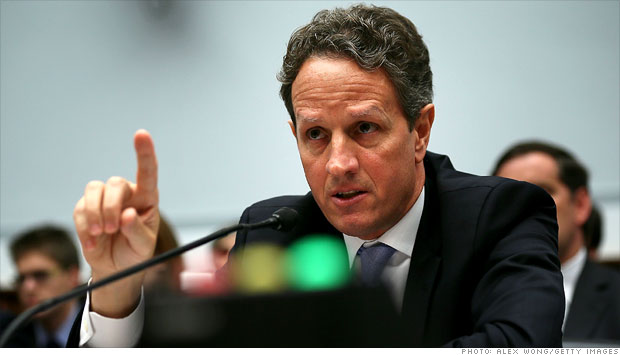
To cut government spending and keep the government from going over the debt ceiling, the government will suspend some investments in pension and health benefit funds for federal workers beginning on Monday, Treasury Secretary Timothy Geithner said in a letter to congressional leaders.

The suspension of the investments is part of a series of measures announced last week to keep the country from defaulting on its debt.

Normally, these measures would buy the Treasury about two months before hitting the debt ceiling, the Treasury has said. But a series of planned tax hikes and spending cuts due to take effect in early January could give Treasury further time if they take effect as scheduled, Geithner said last week.

US Treasury to take steps to avoid debt ceiling
Many analysts believe the measures available to the Treasury can stave that date off into late February.

The U.S. Congress typically authorizes government borrowing in a two-stage process, first drafting plans to spend more than it raises in tax revenues. Every few years, it raises a limit on government borrowing to accommodate annual deficits, a process that this year has become ensnared by the contentious budget talks in Washington.

(c) Copyright Thomson Reuters 2012.

Sunday, August 5

European slowdown hitting some states hard

The European meltdown is weighing heavily on the U.S. economy, with states that rely heavily on exports most at risk from the deepening crisis overseas.

An analysis by Wells Fargo estimates that Utah and West Virginia economies face the biggest risk from the problems in the eurozone, while many Western states including Wyoming and Colorado are unlikely to see much impact.

“The impact of the eurozone recession on each state varies considerably with the mix of goods and services produced and exported,” Wells Fargo economist Mark Vitner said in the analysis.

The European and U.S. economies are linked through numerous ties. The most direct — and most easily tracked — impact centers on a trade relationship that is "the largest and most complex in the world," according to the Office of the U.S. Trade Representative. Those ties generate trade flows of about $3.6 billion a day and account for more than 7 million jobs.

But that money flows unevenly within the U.S., leaving some state economies more vulnerable than others. States with the highest risk of slowing exports are those heavily concentrated in transportation equipment, commodities and chemicals, according to Vitner's analysis.

Those include South Carolina, where more than 250 transportation-related companies employ more than 32,000 workers. Vitner estimates the slowdown in exports over the last year has shaved roughly 1.4 percent off the state’s GDP.

The drop in exports has been partly offset by continued investment in new plants, including a new Boeing aircraft factory. In Alabama, the fourth-biggest vehicle exporting state, weaker demand for cars and trucks is being offset by plans for expanded production by Mercedes-Benz, Honda and Hyundai.

The drop in transportation exports has also been offset by orders from the rest of the world, which has helped blunt the impact on states that rely heavily on aircraft manufacturing. But Washington state, where the aircraft industry makes up 71 percent of exports, remains vulnerable to a further slowdown. With nearly two-thirds of its exports coming from sales of aircraft and related equipment, Connecticut is also vulnerable.

States that rely heavily on exports of commodities face the greatest risk, according to Vitner. Those include Utah and Nevada, with large exports of gold and silver, and West Virginia, a major coal exporter. Slowing chemical exports have hit Louisiana hard. Louisiana’s exports to the eurozone fell 31 percent in the first five months of the year.

The European recession also hurts states that rely heavily on industries such as financial services and tourism.

“European visitors account for around 40 percent of all international visitors to the United States, and the volume of visitors has slowed noticeably over the past few months,” according to Vitner.

Top U.S. destinations include New York, Los Angeles, Miami, San Francisco, Las Vegas, Orlando, Fla., and Washington, D.C. The eurozone slowdown is hitting East Coast destinations the hardest, Vitner said.

The crisis also hurts the financial centers of New York, Chicago, Philadelphia and Boston. As of June 30, the six largest U.S. financial firms by assets had cut more than 18,000 jobs in the past year, or 1.6 percent of the total, according to The Wall Street Journal.

Eurozone woes add to existing troubles
The slowdown comes as states are already struggling with weaker economic growth and persistent pressure on state budgets. Last year, six states — Wyoming, Alabama, Mississippi, New Jersey, Maine and Hawaii — saw their economies shrink.

States with positive growth are still feeling the hangover from the 2007-09 recession, which cut deeply into revenues just as newly unemployed people turned to their services for help in large numbers. Other costs, including for healthcare and public employee pensions, are rising rapidly, forcing cuts in basic services such as law enforcement, schools and transportation.

The budget crunch shows no signs of easing, and states' current spending, taxation and budget practices cannot be sustained, according to an independent bipartisan committee.

As aging populations drive health care and pension costs higher, revenue from sales and gas taxes is shrinking, the group said in a report last week. Meanwhile, grants from the federal government, which provide about a third of state revenue, are likely to shrink, the report said.

The State Budget Crisis Task Force, headed by Volcker and former New York Lt. Gov. Richard Ravitch, studied six key states.

Sunday, April 8

Why we keep hitting send on damning emails

With so many business scandals lately, there’s often a damning e-mail exposing wrongdoing, often sent by high-level employees.


Just last week, government officials investigating the collapse of MF Global released an email from the firm’s assistant treasurer that could implicate the CEO, former New Jersey Governor Jon Corzine.


The e-mail states: “Per JC’s direct instructions” millions of dollars were transferred out of customer accounts to cover a shortfall at the defunct brokerage, an act that could spell legal problems for both Corzine and the treasurer.


E-mail evidence like this isn’t unusual. Last year, an investigation into phone-hacking charges at News Corp. unearthed damning e-mails that showed top managers were informed about widespread illegal activity. And even the Oracle-Google patent fight has a “damaging e-mail” that is part of the saga. According to a recent article in Computer World, Google has been trying to keep an e-mail written by one of its engineers out of the case.


So, the question is, why do people keep putting potentially harmful information in e-mails? Sure, it’s great for prosecutors who want to expose malfeasance at companies, but after so many public e-mail faux pas you’d think people would have wised up.


One of the top reasons they haven’t is “hubris,” maintained Dave Scher, an employment attorney with the Employment Law Group. “People think they’re above the law.”


Scher represents employees in cases of retaliation or discrimination at work, and with about half of his cases he’s able to find e-mails that corroborate or confirm retaliatory or discriminatory conduct.


One of the most blatant e-mails came from a boss who was pretending to be a licensed therapist. When his employees exposed him, the manager sent the worker an e-mail basically stating he was firing him because he revealed his lie. It was a retaliatory move that’s illegal under labor laws.


Indeed, about a quarter of companies have had an employee e-mail subpoenaed as part of a lawsuit or regulatory investigation; and 9 percent ended up in court because of an employee e-mail, according to the most recent report on business communications policies by the American Management Association and The ePolicy Institute. This is despite that about 80 percent of organizations have written e-mail policies, the study found.


Stephanie Weiland Knarr, a licensed psychotherapist from Laurel, Md., isn’t surprised that people who engage in shady acts have no qualms about letting it all hang out on e-mail. “The personality type of someone who is engaging in illegal behavior is often narcissistic,” she explained, adding that they think they’re invisible and above the law. “These types of people like to take risks and even if they’re caught and the writing is on the wall, so to speak, they still deny it.”


What may also be driving some of this is that many employees just don’t take e-mail seriously, surmised Nigel Cannings, technical director for Chase Information Technology Services, a London-based firm that does corporate compliance.


“What we have found is that people just don't think of e-mail as ‘real,’” he explained. “To them it's an ephemeral thing that is sent off into the ether, and which is a) private, and which b) can be deleted. Usually, both are untrue.”


Indeed, in most cases you can’t just scrub your e-mails away if you realize they could be career killers, or land you in legal hot water.


“Depending on industry and the size of an organization, e-mails are immediately written to an enterprise repository, which is accessible by legal and compliance functions. And which cannot be deleted, even if they are deleted from the e-mail client,” Canning noted.


And, he added, “Financial regulators insist that e-mails are maintained for potential later investigation. Increasingly this is the case for IM messages as well, and they are likely to be the next big area where people get caught out.”


It’s not just illegal deeds that are exposed via e-mail. Patti Johnson, a career expert and the CEO of PeopleResults, said the e-mail flubs she sees most include:

The misinterpretation: “E-mails are often misinterpreted because you wrote it quickly, used the wrong tone or copied the world. A poorly worded or quickly written e-mail can send the relationship in a downward spiral because it is misinterpreted.”The misused CC: "This is often the equivalent of saying I need to let your boss know because I'm not sure you will get it done, or I need someone else to be involved. Use the CC with intent or you can end up with a trust issue on your hands unintentionally.”The address mixup: “E-mails sent to the wrong person. Yes, it happens and it isn't pretty. You type the person's name in you are complaining about.”The angry: “E-mails sent when you're mad. This is time to take a deep breath and make sure you have the facts and pause. A good rule of thumb is if you are going to send a flaming e-mail out, sleep on it first or at least walk around the block. Because once it goes - you can't get it back.”

In the end, e-mails are “permanent and very, very mobile,” stressed Margaret King, director of a consumer research think tank, The Center for Cultural Studies & Analysis.


“Never put anything in an e-mail that you would not want quoted in the New York Times,” she advised. “If the material is that sensitive, ask the recipient to give you a call, and transmit that way.”
Site Search